From November to March, the Vancouver airport weather station records precipitation on more days than not. A house or a multiplex built through those months will get wet. Rain on the site is manageable when the wood, the concrete and the openings are protected, and when everything has dried before the walls are closed.
In this post we walk you through what the rainy season looks like in numbers, why moisture in wood matters, and what happens at each stage of a build to keep the home dry: the excavation, the concrete, the framing, the roof and the wall wrap, the windows, and the drying before insulation and drywall. We also cover what the City of Vancouver asks of a building site when rain washes mud toward the street. Every rule and figure links to the page it comes from, so you can read it yourself or show it to your builder.
Environment and Climate Change Canada publishes climate normals, which are 30-year averages for a weather station. The station we use here is Vancouver International Airport. Its 1991 to 2020 normals are built from the records of the Vancouver Int'l A station (climate ID 1108447) up to June 2013 and the Vancouver Intl A station (climate ID 1108395) after that.
Here is the average rainfall for each month of the wet season at that station:
- October: 123.7 mm
- November: 171.2 mm
- December: 155.8 mm
- January: 162.1 mm
- February: 84.6 mm
- March: 104.1 mm
Added together, those six months bring 801.5 mm of rain. The normal for the whole year is 1,119.2 mm. July, the driest month, averages 34.1 mm.
The number of wet days matters too. The same normals count 19.6 days in November, 20.5 days in December and 20.0 days in January with at least 0.2 mm of precipitation. July has 6.2. The air stays damp as well: the average relative humidity at 6 in the morning is 89.0 percent in November and 89.1 percent in December.
Cold nights are part of the season. The station records a low of 0 degrees or below on 10.1 days in December, 10.2 days in January and 9.5 days in February. Heavy rain days are fewer: 6.7 days a year bring 25 mm of precipitation or more.
These are airport figures, so rainfall on your own street can differ. They still give the pattern to plan around: from November through March, every month at the station has precipitation on more than half of its days.
In a wood-frame home, the wood takes in water when it is wet and gives it off when the air is dry. Builders measure this as moisture content: the weight of the water in a piece of wood compared with the weight of the same wood when fully dry. The Canadian Wood Council explains that a board at 25 percent moisture content is one fifth water by weight. It also says lumber stamped "S-Dry" was surfaced at a moisture content of 19 percent or less.
The Guide for On-site Moisture Management of Wood Construction, written by FPInnovations with funding from BC Housing and the Province, is the main source for this post. It makes three points a homeowner should know:
- Ordinary framing handles surface wetting. The guide says stick-built light wood-frame houses can generally accommodate wetting well, because dimension lumber and thin panels dry quickly when conditions allow.
- Long wetting causes the damage. The guide says the length of wetting often matters more than the total amount of rain, and that rainy coastal winters with long runs of wet days put large moisture loads on materials left exposed on site.
- Closing in wet wood traps the water. A wall, floor or roof should not be closed in until the wood has dried to a moisture content typically below 19 percent. Modern walls hold more insulation and use membranes that let less vapour through, so they dry more slowly once closed.
The guide reports what this looks like on real jobs. In a study it cites, the studs and bottom plates of wood-frame buildings under construction in a Coastal BC winter averaged "about 20%" moisture content before the buildings were closed and heated, with some readings above 30 percent. In summer in the same area the average was "about 15%".
The guide lists what wet wood can lead to: staining, mould, and swelling and shrinking that cause nail pops and drywall cracks, with fastener corrosion and decay after long wetting. BC Housing's Residential Construction Performance Guide says on page 6 that normal shrinkage of materials such as concrete and wood is not covered under home warranty. So drying the frame before it is closed protects the finishes you will live with for years.
Rain affects each stage of a build differently. Here is what happens at each one and what it means for your home.
Rain on bare soil turns into muddy water. The City of Vancouver's erosion and sediment control bulletin for small lots (Bulletin 2002-002-EV, revised March 1, 2017, which we read through the Internet Archive copy of November 30, 2025, because vancouver.ca did not open for us) explains why: sediment washed off a site enters the storm sewer, which flows to the nearest body of water, and it can also plug catch basins and cause local flooding.
The bulletin applies to sites under 1,000 square metres with excavation one storey deep or less. Its practices include:
- Time clearing and excavation so they happen no sooner than the next stage needs.
- Cover soil piles with plastic or tarps, and drape the excavation walls until the foundation is poured.
- Put down a gravel access pad so trucks do not track mud onto the street.
- Use silt fences around soil piles and slopes, and sediment sacks in storm drains within 30 metres downhill of the site.
- Backfill the basement walls and rough grade the lot as soon as possible.
Soil on the street must be cleaned up right away with shovels, brooms or a sweeper, never washed into the drain. The bulletin quotes section 3.2(1) of the Sewer and Watercourse By-law No. 8093, which bans discharging contaminated water into a storm sewer, and says violators face fines of up to $10,000 per offence.
Concrete needs its own protection from the weather while it cures. BC Housing's Builder Guide to Site and Foundation Drainage gives two short instructions on page 26: keep concrete from curing too fast in hot weather by covering the pour and keeping it moist, and do not pour in freezing conditions.
With 9.5 to 10.2 days each month from December to February when the airport station drops to 0 degrees or below, a winter foundation needs a crew that watches the overnight forecast and protects fresh concrete. The same page asks for a vibrator in tight corners and deep forms, and for crack control joints in walls and slabs. The guide says well-consolidated concrete with few cracks or voids is itself an excellent moisture barrier for a basement.
Framing is when the wood is most exposed. Sheathing is the plywood or OSB (oriented strand board) panels nailed to the outside of the frame. The Canadian Wood Council's bulletin and the BC Housing guide agree on the basics:
- Have lumber delivered as close to the day it will be used as possible.
- Keep bundles 6 to 8 inches off the ground on supports, on a clean, well-drained storage area.
- Keep the factory wrap on until the wood is used, and re-cover with a tarp if the wrap tears. The BC Housing guide says tarps should let moisture out, because plastic can trap water inside a pile.
- Remove standing water from floors after heavy rain. Floors and roof decks take more rain and dry more slowly than walls, and water pooling where the wall plates sit on the subfloor can get trapped there.
Panels need extra care. The BC Housing guide says plywood and OSB soak up water readily but dry more quickly than thicker products when conditions allow, which is why wet sheathing on a house frame is usually not a large concern. Large engineered beams and built-up members dry slowly after deep wetting, so they need more protection.
The BC Housing guide says the shell of the building often gives the wood inside an effective and economical shelter. Each upper floor or roof protects the floors below, especially when the joints in the sheathing are sealed. It then gives the order of work: when the wood is dry enough, install the roof sheathing and roofing membranes and the exterior wall barriers as quickly as construction permits.
The water-resistive barrier is the wrap or membrane on the outside of the wall sheathing. It sheds any water that gets past the siding. The guide says the membranes should be sealed and continuous where they meet, and that large openings for windows, doors and skylights should be covered with see-through membranes until the windows go in, so light gets inside and rain stays out.
Many walls also use a rainscreen: a narrow air gap between the siding and the wall, so water can drain out and the wall can dry. BC Housing's Builder Insight No. 6 says rainscreen walls became common practice across coastal BC after the moisture problems of the mid 1990s. It reports six years of monitoring on five Vancouver buildings and found these walls generally working well in Vancouver's climate. It says a continuous gap of 10 mm to 19 mm is generally enough. It also found that buildings with roof overhangs of 24 to 48 inches received less driving rain on their walls than buildings with overhangs under 12 inches.
Window openings are a common entry point for water. In a 2006 presentation to the BC Building Envelope Council, researchers from the National Research Council and CMHC reported that CMHC's surveys attributed at least 25 percent of wall moisture problems from water entry to the windows or the joint between the window and the wall. The most frequent path was through that joint into the wall beside the window.
Careful work around the opening reduces this risk. Flashing is the formed metal or membrane that sends water out and away from a joint. The presentation recommends windows installed with a second layer of protection, such as drainage under the sill that lets any water that gets in run back out. Builder Insight No. 6 gives a Vancouver example: one of the two leaks found in the monitored rainscreen walls was below a window corner that took heavy runoff.
Test before you close the wall. The Performance Guide's water test (Appendix A5, page 326) uses a garden hose with a shower spray for no more than 10 minutes, from at least 2 metres away, with a second person watching inside. Under section 3.5 on page 50, windows shall not let in unintended water under normal design weather when properly closed, and the guide lists 5 years of coverage for that kind of water entry.
This stage decides whether the rain causes lasting damage. The BC Housing guide's construction checklist asks whether moisture content is being measured. If readings are repeatedly above 20 percent, it calls for drying measures such as space heating and forced ventilation before the walls are closed. It also says spray foam and self-adhesive membranes should not be applied to wet wood.
Builders use two kinds of handheld meters. One pushes two pins into the wood. The other reads through the surface without leaving holes. The guide says both work from 6 to 25 percent when calibrated, with errors of plus or minus 2 percent, and that plywood, OSB and treated wood need their own corrections.
Temporary heat helps, and the kind of heat matters. The guide lists space heating, dehumidification (machines that pull water out of the air) and forced ventilation as ways to speed drying before the walls are closed. It also warns that heating with a fuel such as natural gas or propane adds moisture to the air from the burning itself, and can become a fire concern on a construction site. The Canadian Wood Council bulletin says the same about timing: do not hurry to close in walls that have been wetted, and allow time and airflow for the wood in the wall cavities to dry first.
A multiplex has more units and more floors than a single house. The BC Housing guide says moisture protection becomes more important as buildings grow in height and area, because a larger frame can stand in the weather for longer and fast schedules may not leave enough time for drying.
Site rules can change too. The City's bulletin for large lots (Bulletin 2002-003-EV, revised March 1, 2017, read through the Internet Archive copy of November 30, 2025) covers sites of 1,000 square metres or more, or with excavation deeper than one storey. Those sites must submit an erosion and sediment control plan with the building permit application. A qualified person tests the water leaving the site: on a schedule the bulletin calls bi-weekly from May to September, every week from October to April, and again within 24 hours of a day with more than 25 mm of rain. The bulletin sets discharge limits of 75 mg/L of suspended solids and a pH of 6.0 to 9.0, and says a failure to follow the plan can lead to a stop work order.
If your multiplex has an underground parking level or a deep basement, ask your design team early which of the two bulletins applies. City rules change, so confirm the current version with the City of Vancouver before you rely on it.
Plan the Schedule Around the Roof. The BC Housing guide suggests framing and closing in during a drier season where possible. If your frame will go up in the wet months, ask how soon the roof and wall wrap will follow.
Ask Where the Lumber Will Sit. Look for a clean, drained area with the wood off the ground and covered.
Keep Water Off the Floors. Ask the crew to sweep water off the subfloor after heavy rain, especially at the base of the walls.
Ask for Moisture Readings Before Insulation. A list of readings by room and wall shows whether the frame has dried to the level your builder is aiming for.
Watch the Window Openings. Ask to see the sill and flashing at one window before the siding goes on, and ask for a water test.
Choose Overhangs With Care. In the Vancouver monitoring study, buildings with 24 to 48 inch overhangs received less driving rain on their walls than buildings with overhangs under 12 inches. Overhangs are a design choice, so raise them early.
Costar's process page describes the construction stage this way: the team excavates and pours the footings and foundation walls, builds the floor joists, frames and sheathes the exterior, and orders windows and doors, while a Costar construction manager supervises the crew and subtrades. That is Costar's own account of its process. Ask your Costar consultant how the schedule for your project handles the wet months, and when the roof, the wall wrap and the windows are planned to go on.
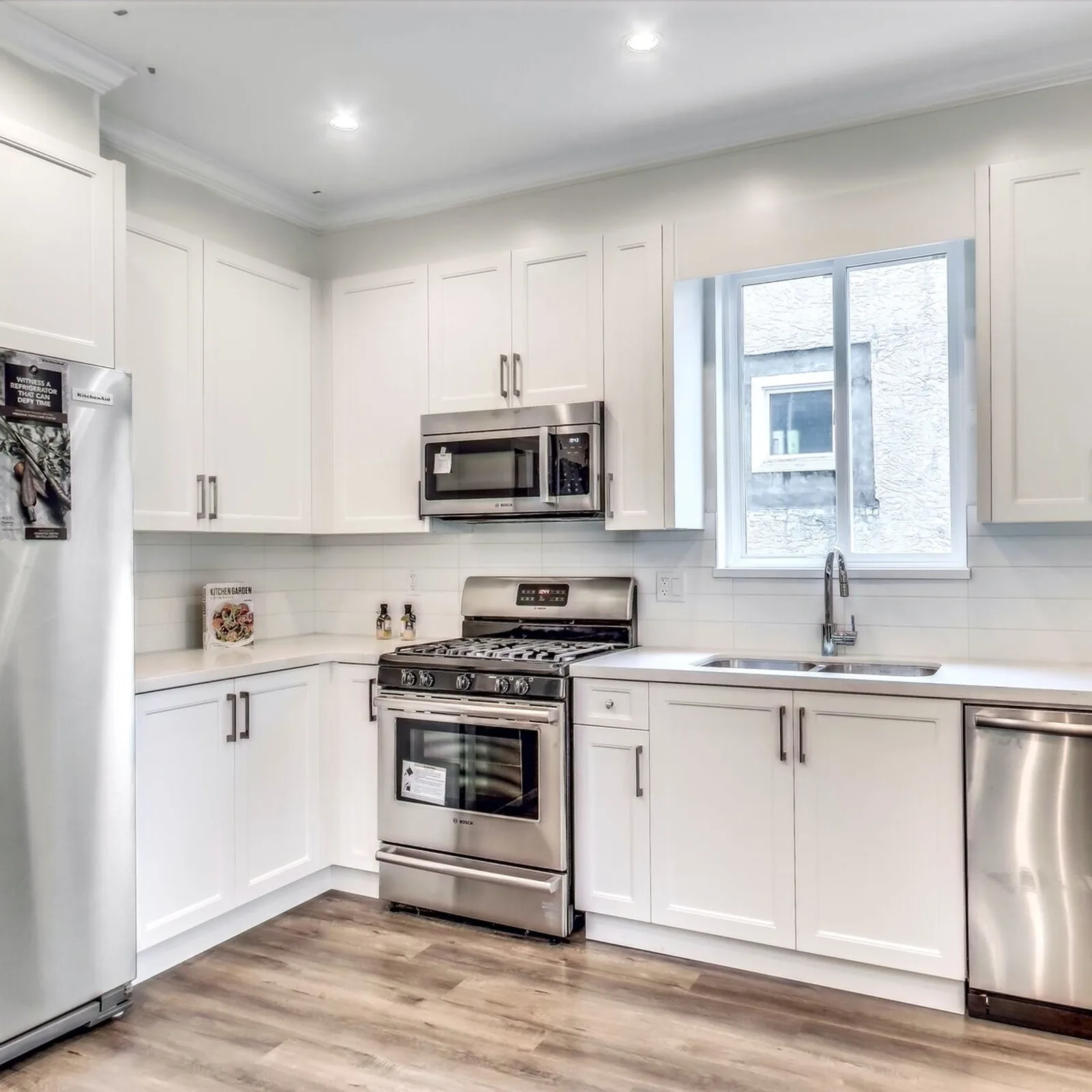
You can also see the result. The Vancouver Dunbar Custom Home at 3360 West 30th Avenue is a single-family home in Costar's project gallery, built under Costar's custom home construction and management scope. The finished rooms in the cover photo of this post come from that project. For what to check when your own home is finished, read our post on the new home handover walkthrough.
If you are planning a custom home or a multiplex in Vancouver and the build will run through the rainy months, we are happy to explain how we would schedule it. Tell us about your project today.
Related on this site: Custom home construction in Vancouver · Multiplex construction in Vancouver · Building in Vancouver · Book a one-hour project consultation